
Decoding Tumour Deposits: Computational and Morphomolecular Approaches to Study the Metastatic Spread via Tumour Deposits in Colorectal Cancer
Aim
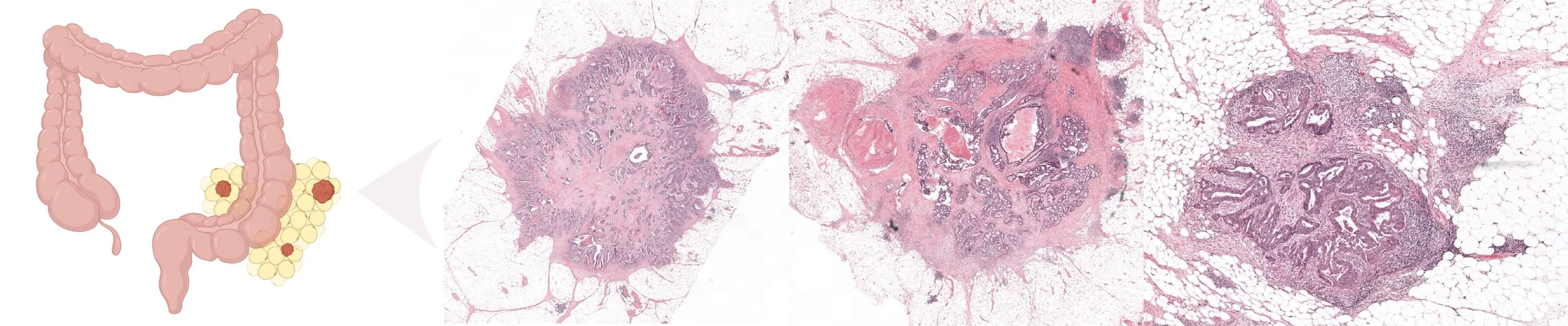
Tumour deposits (TD) are discrete aggregates of malignant cells found in the pericolic or perirectal fat within the lymph drainage area of the primary tumour, and occur in approximately 20% of colorectal cancer (CRC) cases. Despite their association with poor prognosis, TD remain incompletely understood in terms of their biological origins, morphomolecular characteristics, and metastatic significance. Under the current TNM staging system, TD only influence staging when lymph node metastases (LNM) are absent, yet evidence suggests they carry independent prognostic value and may represent a distinct route to distant metastasis. A deeper understanding of TD biology is therefore needed to improve CRC staging, risk stratification, and treatment decisions.
We hypothesise that systematic morphomolecular characterisation of TD, integrating computational pathology, spatial transcriptomics, and digital image analysis across multi-institutional cohorts, will reveal biologically distinct TD subtypes with differential prognostic and therapeutic relevance. To test this hypothesis, our project aims to achieve the following objectives:
Develop and apply computational algorithms to detect and classify TD in large H&E-stained CRC cohorts, establishing their prevalence and clinical impact
Characterise the morphological and molecular composition of TD and their microenvironment, and compare these profiles to those of primary tumours, LNM, and distant metastases to elucidate metastatic pathways
Identify primary tumour features that predict TD development
This project combines advanced computational biology with digital pathology and multi-omics approaches, with the ultimate goal of refining CRC staging systems and supporting more personalised treatment strategies for TD-positive patients.
Members
Nina Baumgartner

Inti Zlobec

Heather Dawson
Funding source
Collaboration
Iris Nagtegaal (Radboudumc)
Gina Brown (Imperial College London)
Robert Zboray (EMPA)
Henning Müller (HES-SO)
Ludovico Silvestri (University of Florence)