
Spatial transcriptomics of colorectal and rectal cancer: from method benchmarking to treatment response
Aim
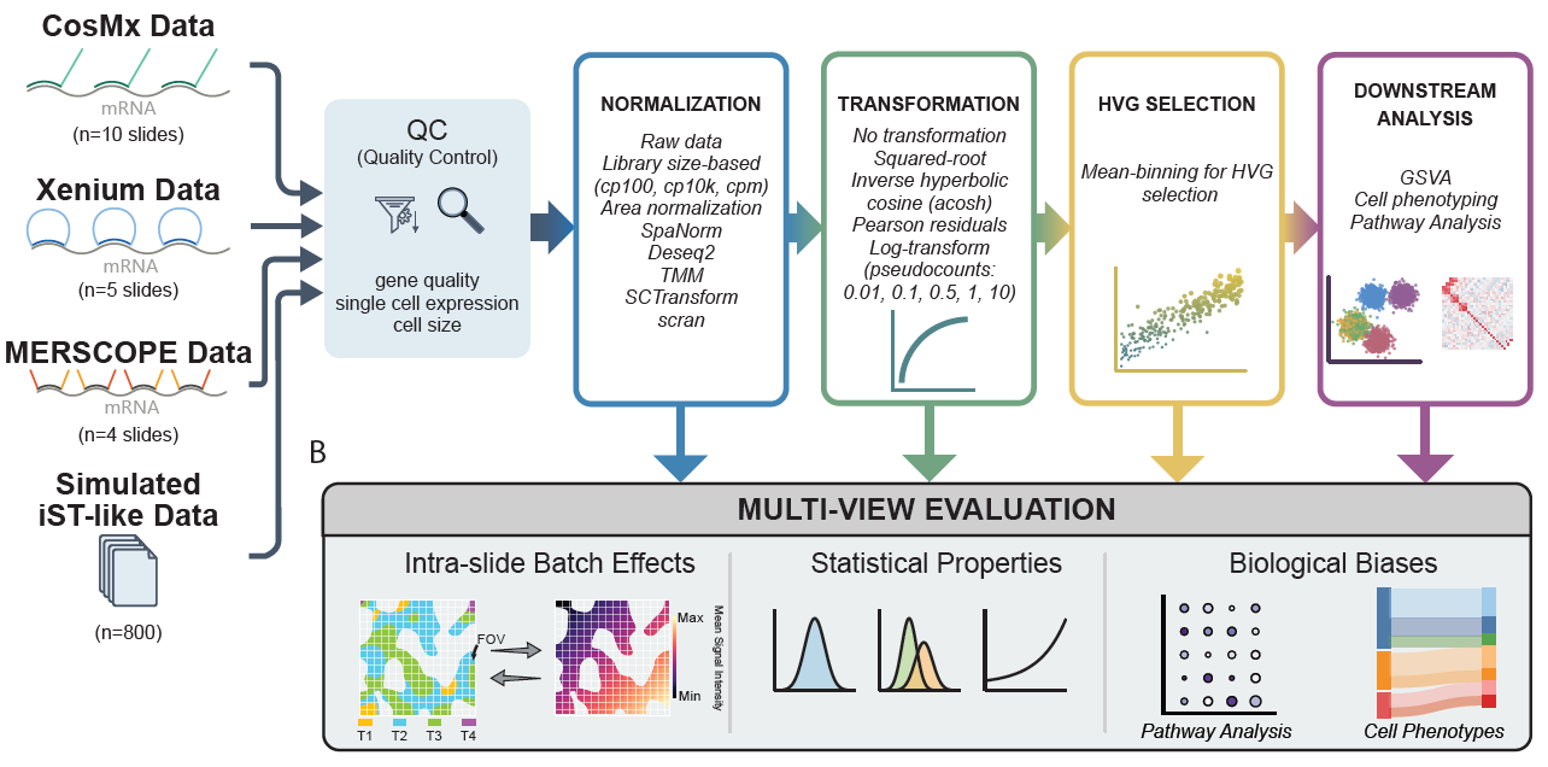
Image-based spatial transcriptomics (CosMx, Xenium, MERSCOPE) measures thousands of genes in intact tissue at single-cell resolution, yet the data are still processed with methods inherited from single-cell RNA sequencing. José developed BISTRO (Bias Identification in Spatial TRanscriptOmics), a benchmarking framework that evaluates how normalization, transformation and gene selection reshape the statistics and the biology of these data. Across 7.7 million cells from 19 slides and three platforms, BISTRO identified an intra-slide batch effect linked to the field-of-view acquisition order that no normalization removes, showed that log-transformation fails to stabilize variance because targeted panels compress the dynamic range of expression, and found that the choice of normalization drives which genes, pathways and cell types are recovered, whereas gene selection adds little over random gene sets. The framework was validated on an in-house colorectal cancer tissue microarray (TMA) and is openly available as a Nextflow pipeline.
He now applies this pipeline to rectal cancer, where response to neoadjuvant therapy is highly variable and cannot be predicted from the diagnostic biopsy, the only tissue available when treatment is decided. Three TMAs built from the biopsies of more than 180 patients with different stages and degrees of response have been profiled with the CosMx 6,000-plex panel to ask how tissue organisation differs between responders and non-responders. During a six-month research attachment with Joe Yeong at the A*STAR Institute of Molecular and Cell Biology in Singapore, the project will be extended to the matched surgical resections of the same patients, combining spatial transcriptomics with imaging mass cytometry to characterise how therapy remodels the tumour microenvironment in each group.
Members

Inti Zlobec
Funding source
Swiss Cancer League
Collaboration
Thibaud Kössler & Claudia Corro (University of Geneva)
Joe Yeong (A∗STAR)
Rong Fan (University of Yale)
José F Carreño-Martínez
Maria Martinez Rodriguez