
From matrix remodeling to therapeutic targets: investigating CAF-driven desmoplasia in colorectal cancer
Aim
Desmoplasia is a typical trait of tumour biology and it consists of the the excessive deposition of extracellular matrix components such as fibrillar collagens and fibronectin leading to a dense and fibrotic tumour stroma. A marked desmoplastic reaction has been linked to increased tumour aggressiveness and impaired drug delivery in colorectal cancer. Desmoplasia can be classified into histological subtypes, with the mature subtype associated with a more favourable prognosis and the immature or myxoid subtype linked to poorer outcomes. Understanding the biology that underpins desmoplasia and identifying novel therapeutic targets therefore represents an important clinical challenge. Cancer-associated fibroblasts are major contributors to desmoplasia through their capacity to deposit and remodel extracellular matrix, yet the processes that drive and sustain this activity remain incompletely understood. Preliminary evidence from breast cancer points to a role for cancer-associated fibroblast autophagy and altered metabolism in initiating and maintaining the desmoplastic reaction, but whether this applies to colorectal cancer remains to be elucidated.
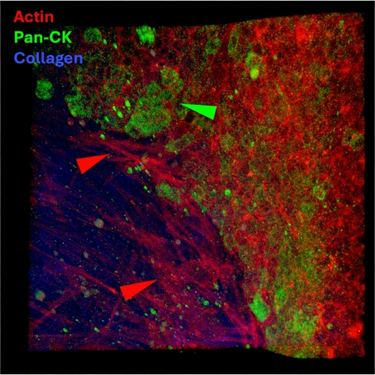
Fig. 1. Multi-photon imaging of 3D spheroid co-culture dermal fibroblasts with HCT116 colorectal cell lines. Red arrows: dermal fibroblasts interfacing with spheroid surface. Green arrow: tumour cells within spheroid.
Members

Letizia Spitti

Hannah Williams

Heather Dawson
Funding source
Institute of Tissue Medicine and Pathology, University of Bern
Collaboration
Mario Tschan (Institute of Tissue Medicine and Pathology)
Martin Sadowski (Institute of Tissue Medicine and Pathology)
Olivier de Wever (University of Gent Belgium)